
What is the Science of Writing?
The “Science of Writing” is a large and diverse body of evidence that points to the most effective ways to teach writing.
For two decades, the team at Releasing Writers (formerly think SRSD) has worked to implement this in our classrooms, schools and across full states. We have also been fortunate enough to partner with researchers, win grants and study the impact of our efforts. The science of writing originated with Meichenbaums’ work in 1971, Kanfer’s in 1972, then Deshler’s University of Kansas’ Strategy Instruction Model (SIM) in 1981, Harris’ SRSD framework (1985) that replicated Deshler’s and added elements from Dr. Carol Sue Englert. While grounded in this framework, we also draw on: Olson’s Cognitive Strategies Instruction, Haynes’ Structured Written Expression work, Datchuk’s Sentence-Level, University of Missouri’s Data-Based Instruction, and Truckenmiller’s writing assessement work. While many more have contributed to the ever-evolving body of evidence, the team at Releasing Writers has been tracking, testing and refining how to integrate this body of research into a light-lift, high yield approach.
Supported by decades of research, Releasing Writers combines explicit writing strategies with tools for self-regulation and in ways that address the multiple levels of language and latest wider literacy advances.
Releasing Writers specializes in providing professional learning on the Science of Writing, particulary well-supported models such as SIM, SRSD or Cognitive Strategies Instrucion (CSI). We tailor these to integrate with your school setting and existing curriculum. Like most researchers, our team has adapted the findings from large studies in ways that balance fit and fidelity, but maintain the core key elements, many of which originated with Donald Deshler (6-Step Gradual Release), Carol Sue Englert (creator of POWER) and well as later advances that have looked at which areas of writing best predict overall quality.
Our team‘s peer-reviewed studies specialize in translating this powerful model into real-world classroom success and addressing its barriers — with the goal of helping educators . See our new Google Scholar Page for the full history and list of Releasing Writers (formerly think SRSD) peer-reviewed studies.
📘 Download our 4-page brochure to quickly understand how to use this approach with your students.
Benefits & Features
- Explicit, Structured Writing Strategies
-
Students learn how to plan, organize, write, revise, and reflect step by step.
-
Built-in Self-Regulation Skills
Students develop confidence, persistence, and motivation through modeling, goal setting, and reflection. -
Proven Across Grades & Populations
From early elementary to high school, and across diverse learning needs, SRSD adapts and delivers.
Rooted in the Self-Regulation Theory (Originated by Meichenbaum, Kanfer) & Operationalized for Student Instruction at University of Kansas in their 1970s SIM – Strategies Instruction Model.
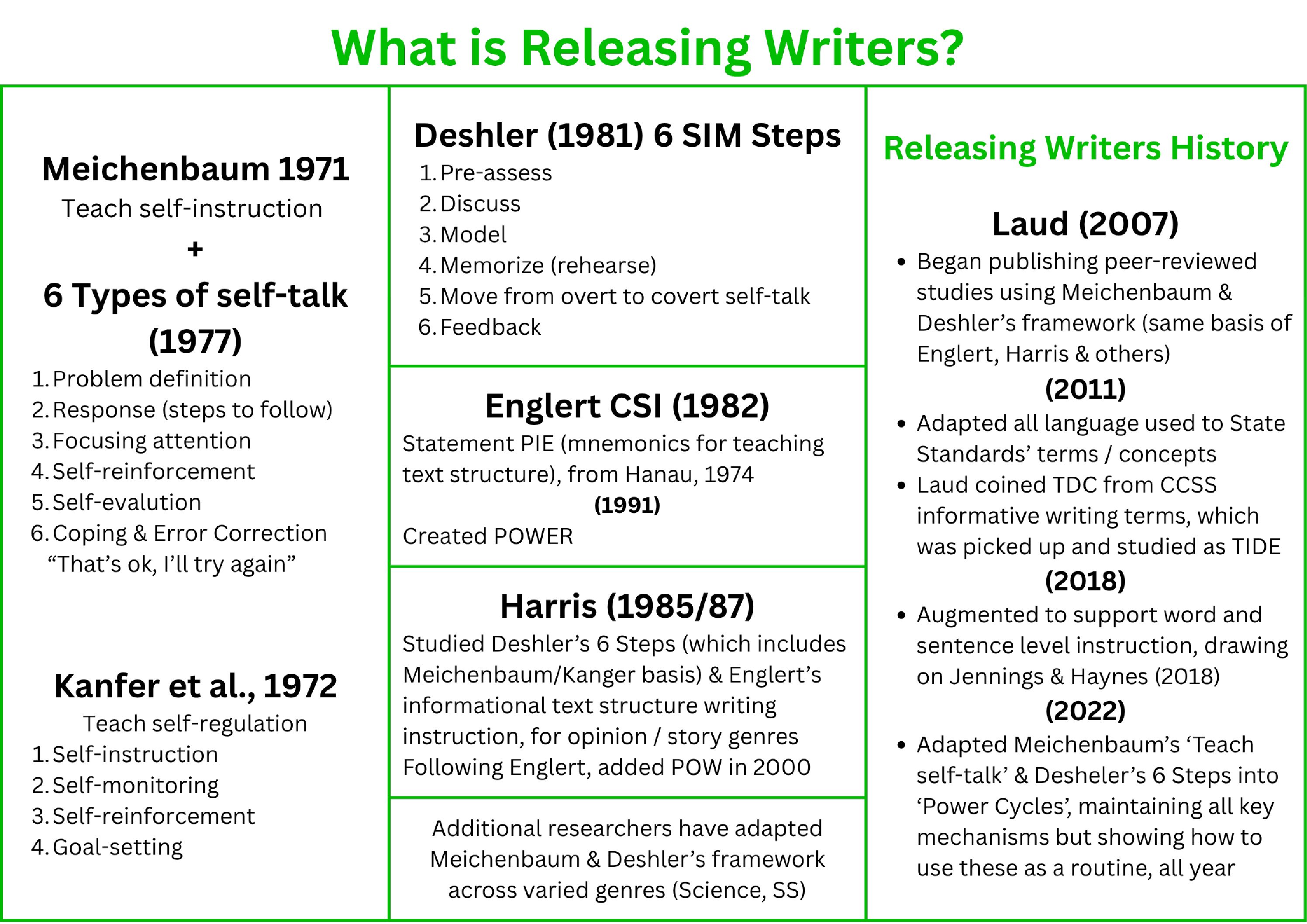
Evidence-based frameworks for writing instruction such as Deshler’s Strategies Instruction Model (SIM) and SRSD, Releasing Writers supports using a flexible gradual release model that includes: (1) Develop Background Knowledge, (2) Discuss It, (3) Model It, (4) Memorize It, (5) Support It, and (6) Independent Performance. Teachers guide students through activities as they initially learn to write independently, then shift the focus after students achieve independence.
Lesson 0: Pre assess & Set Climate
Teachers create a warm, purposeful, and reassuring climate that positions pre-assessment as inviting students to showcase their strengths and prepare to set meaningful goals before formal instruction begins.
Lesson 1: Tools & Exemplars
Teachers introduce the POWeR writing process alongside the TIDE-L organizational framework, then guide students through a close, color-coded analysis of a carefully chosen exemplar that makes the features of effective writing visible, concrete, and immediately aspirational.
Lesson 2: Collaborative to Independent Practice
Teachers orchestrate rich, collaborative reading, speaking and writing experiences in which POWeR and TIDE-L comes alive through daily self-talk, think-alouds, pair sharing, and high-ratio student talk, building the skills and confidence writers need to respond to high-rigor prompts and complex-text. Through repeated practice and explicit support in memorizing each mnemonic, teachers gradually release students across roughly ten POWeR Cycles until students almost ‘back-pocket’ the strategies and become drivers of their own learning, making the more rigorous learning more accessible and joyful.
Lesson 3: Scoring & Goal Setting
Teachers empower students to become precise, honest evaluators of writing by guiding them through collaborative scoring of exemplars and below-standard pieces, transforming assessment into a motivating, goal-driven practice rooted in growth and deepening ability to produce increasingly better writing. Students must memorize and internalize the language of the scales, terms drawn directly from the standards and anchored to the highest level of performance, because without deeply understanding the ideas behind these terms and the level of writing they describe, students cannot self-regulate toward reaching those standards. As Kanfer (1972) established, self-regulation depends on the clarity and explicitness of the performance standard itself. Students demonstrate that understanding when they use these terms naturally, and ultimately when they call them up and use them privately as they write alone, since writing is at its core a private act guided by an inner voice, and it is precisely these terms that give that inner voice what it needs.
Lesson 4: Revise & Edit
Less a new lesson than a natural deepening of Lesson 3, Lesson 4 enriches scoring by weaving in explicit instruction and modeling on the power of revision, using a peer’s below-standard draft to give students the emotional distance that is often hard to hold when revising one’s own writing. That small but important shift helps students discover that revision is where good writing becomes truly excellent. Woven into weekly scoring routines (sometimes called “Feedback Friday”) across every POWeR Cycle, revision becomes an expected part of writing at all phases, taught and supported until students revise as fluently as they plan.
Lesson 5: Plan & Organize
Teachers guide students to independently discover the organizational structures of any text type by teaching “back mapping” – deconstructing exemplars back into TIDE-L or CSPACE-L ‘jot talk’ filled organizers, cultivating flexible, transferable planning habits that make writing feel purposeful and manageable across every genre.
Lesson 6: Self-Regulation
Saving the best for last, in Lesson 6, teachers even further open up the writer’s mind by modeling rich, relatable self-talk (or ‘replacement talk) and self-regulation strategies through think-alouds, equipping students with the inner language of confidence, persistence, and strategic self-direction they need to guide themselves through every step of the writing process. All through from Lesson 0, teacher instruct students in what self-talk is, how to use it, model using it and scaffold student use. This final lesson further deepens, centers and expand this key element.
Laud’s POWeR cycle framework offers a comprehensive system that students use to direct themselves through the writing process and continuously set new goals for themselves. It fosters equity because it systematically and explicitly teaches the skills, strategies and self regulation that good writers use.
What is the POWER Cycle?
The first time teachers introduce new strategies, instruction often takes about two weeks, with the most time spent in collaboraitve writes. We then use an ‘I do, We do, You do’ – gradual release framework – that we call the POWER Cycle.
The Power Cycle offers a next-step simplified way to envision the content of the 6 stages applied over a full school year.
“POWER” (Englert et al, 1991) provides a reminder to use all the phases when we write rather than dashing to drafting, then ending. POW was then introduced in SRSD in 2003.

How the POWeR Cycle
Supports Gradual Release
Releasing Writers schools see greater ELA gains each year now. To ease adoption and increase impact, we shifted focus from 6 Steps names used by Deshler (later termed stages by Harris) to what you DO in each phase, emphasizing gradual release all along. Teachers introduce and discuss the key strategies and self-regulation skills (usually about a day). You then model these but also support memorization and how to use them collaborative writes (repeated all year with less support as students master new skills, standards or genres introduced in each).
At the lightning bolt ‘lift off”, the lift is taken off the teacher and placed on the students (lift off!) as they perform increasingly independently and move forward to a deeper and more empowered ongoing model of self-driven learning.

Frequently Asked Questions (FAQ)
What grades is Releasing Writers for?
K–12. We tailor our approach based on your students. To make the course cost efficient for you, we include all materials for K-12 in one course, labeled carefully in specific sections so you can easily find your own grade band.
Does Releasing Writers replace our curriculum?
No. Releasing Writers is an integrative approach that is designed to embed seamlessly with what you already use. We offer specialized courses to help you integrate with all major HQIM or self-created curricula. If you prefer, we also have stand-alone Lesson Plan units, but we find most schools want to integrate with their exisiting SS, science and ELA curricula right out of the gate. Our ‘Power Cycle’ makes this easy to do.
How is Releasing Writers (formerly think SRSD) unique?
We offer live PDs and meetings, led by teachers, coaches and school leaders who have all used the approach and seen ELA impact. We have also developed scaffolds to help you launch available only at our TPT think SRSD site. Our goal is to make it easy for you to launch evidence-based practices in ways that lead not just to writing growth, but overall ELA proficiency gains.
Is Releasing Writers research-based?
Yes. Releasing Writers includes the key ingrediants from decades of peer-reviewed research – and proven implementation in our schools nationwide. We are built on this research, and have followed careful fit and fidelity guidelines to make Releasing Writers easier to pick up and show wider ELA impact (gains in reading comprehension, sentence quality and further areas.) After facing barriers around how to integrate common well-supported isolated writing instruction models with the day to day needs of teachers, we discovered how to integrate multiple evidence-based practices for teaching reading and sentence writing with writing instruction in our unique POWeR Cycle model.
Can we customize how we implement the Science of Writing?
Absolutely. Everyone does. We have yet to see two schools take this on without customizing away. We guide schools with specialized ‘fit and fidelity’ tools to help you embed Releasing Writers nto your existing curriculum and align with state standards, as well as to meet local context needs. We honor and respect teacher-expertise. Our team includes school-based practitioners who have used evidence-based approaches for teaching writing for decades, tracking the research and adapting it to fit the needs of our varied contexts in ways to make it endure over time and lead to greater ELA proficiency gains.
Built by Teachers. Backed by Evidence. Focused on Results.
Releasing Writers, formerly think SRSD, is led by Dr. Leslie Laud, a teacher, principal, researcher and national consultant who has served as Principal Investigator on multiple federally funded studies. With real classrooms at the center of everything we do, we’re proud to help districts nationwide transform writing instruction and achieve real results.
About Us
Releasing Writers is the community of teachers and researchers who use and study practical applications of the Science of Writing. We offer in-person professional development and e-learning courses taught by teachers with decades of experience using our framework. Since offering the very first open enrollment course in SRSD in 2008, our group has grown to lead courses on multiple evidence-based practices for teaching writing and to integrate these.
Join our Newsletter
Get Involved