
The Essential Role of Our 20-Point Scales
For students to take themselves through the writing process and produce a high-quality piece, they need the language to self-regulate — language that they can use to walk themselves through each step and that tells them what a strong paragraph, and each part of that paragraph, requires for it to be high quality. This is an and/both.
At the global level, this starts with POW (or POWER). Students write it down, check it off, and eventually internalize it, so they know they have to move through every stage of the writing process.

The and/both is that – Inside POW, for the O (organize), they then build a TIDE-L from start to finish and translate it into sentences. Doing that well requires more than knowing the criteria for each part. It requires having internalized the language for each part. The language they use to think about and craft each T, each I, each D, each E, and each L is the same language that they use to self-regulate as they write.
Exemplars (like above) alone help, but don’t get them there. Those can help them see what quality looks like. They see a strong topic introduction. They see not just evidence – but well chosen evidence in these exemplars. Even more granularly, they see and they may even “borrow” (and must eventually memorize and internalize) strong sentence stems they see in exemplars, but they need more.
They need to have the language to be able to name what is happening, what is going well, in each section of the exemplar, from its overall structure to why each section is strong, why each sentence is well constructed and even vocabulary well chosen.
They cannot keep referring back to these exemplars or lists of its qualities (or stems, or printed scoring guidelines) and still be taking these out after a few weeks, or writing becomes mechanical.
Here is the key: They must memorize and pull up this language (qualities listed in scoring guidelines down to more granular sentence stems), and do so naturally.
This is the secret our strongest writers are already in on, and our job is to open the black box so every student has access to it.
The knowledge can’t sit as a vague posted list of “what makes writing good.” It has to be organized and categorized under each part of TIDE-L so students can rattle off what makes a T strong, what makes an I strong, and so on. Ask any expert writer what makes each part good and they’ll tell you — that language is exactly what’s guiding them internally as they produce each part.

Early on, a rocket is enough, and students can work from the criterion of “I have all my parts.” But to keep improving past that point, each part has to be high-quality, not just present. Caveat – Britt Root (Gr 5 teacher) loved the rockets and came up with a fantastic innovation that works too! Embed the complex language right in the rockets. There are various ways to help students learn the language of the scale, but learning and memorizing this is key. Never bring down the language to make it student friendly; Bring the students up to the language. The concepts are all vital and need to be learned, internalized and used.
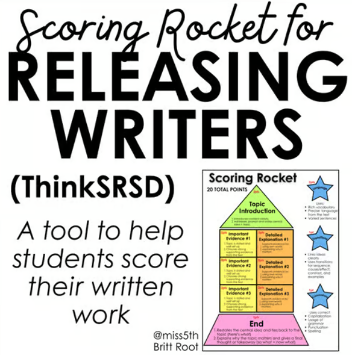
(Pro tip: Scoring student writing with colleagues is hands down the best way for you to learn the language of the scales, deeply internalize it and be ready to then teach it to your students more easily.)
In this way, the preassessment of text-type terms connects directly to the scales — to the language on them and to the scoring guidelines. This preassessment that we do at the beginning of instruction, gives us a view into whether our students already know these terms and more importantly, understand the concepts that the terms represent. It is both – they need to understand the concept they need to be able to identify the concept in an exemplar and they need a label, a name, for the concept because it is that label or that name that they are using to guide themselves when they are producing a strong paragraph on their own.
These terms are what students use to set goals – but after that they also help them self regulate working to meet their goals independently.
This work isn’t easy. The scales can feel too detailed and their value is so easy to overlook. This can be one of the greatest impediments. Teachers use POWeR and TIDE-L but may still not see gains. This is because those alone do not bring enough heft to move the dial on facilitating self-regulation.
The scales are what move self-regulation past “I included all my parts” and into the quality of each part. The language on these scales is what moves a writing from a student who follows along during a collaborative write over to a student who now takes him or herself through creating an outline then paragraph on their own, without guiding them. One of the most common questions we get is how to move students along to independence. This language on these scales is what moves the gradual release along.
At first the mnemonics help them self-regulate, but they are not enough and will not sustain alone. Likewise, even exemplars are not enough. They show students what strong writing looks like. But – the scales give them the names for it, the names for the underlying quality concepts. The names are what let them hold the concept in mind, draw on the exemplars they’ve seen, and use words to guide their own writing toward that same level of quality.
And remember, even reaching independence is not the final goal post. That is the doorway to a new kind of learning, the kind Zaretta Hammond describes as giving students more learning power. Once they begin to grow and use this, the entire culture of our classrooms changes forever and there is no going back once we see it happen!
Note: Special thanks to Jen Spronck for posting this video in our Facebook Group that sparked this epiphany for me!