
This post is a love letter to Quick Writes – how they came to be, how the field shaped, studied and refined them, and why building them into your weekly routine might be one of the highest-leverage instructional moves you can make – all with TIDE-L at the center!
Where It All Began: Strategy Instruction and Self-Regulation
To understand Quick Writes, you have to go back — all the way to 1981 and earlier, when researchers at the University of Kansas began building out what became known as the Strategies Instruction Model (SIM), originated and created by Don Deshler and his colleagues. These dedicated thought leaders were asking a deceptively simple question: how do you teach students to use their minds more strategically when reading and writing? Their answer was to make the invisible visible — to name cognitive and affective processes explicitly, build mnemonic structures students could hold in memory to remind them of what to do, and to use self-instruction to regulate their own performance.
This was genuinely revolutionary. And it laid the intellectual foundation for everything that came after in strategy-based writing instruction. And for how strategies became never an end in themselves but a powerful way to get students to engage more deeply with academic language so that they could more efficiently absorb and gain mastery of it. Strategies are tools that support this.
In the 1980s, researchers began extending and validating this approach across different writing contexts. The core insight — that struggling writers don’t lack intelligence or the ability to learn to use academic language, they lack a strategic framework. This insight proved remarkably effective. I came to this work in those years, learning to design mnemonics directly from Don Deshler’s framework and guidance.
The discipline of mnemonic design is more demanding than it looks: the letters have to be memorable, the words behind them have to name a process (step) or product (outcome). My first efforts to design mnemonics were clunky but still worked (Laud et al, 2008).
Linda Mason and the Quick Write Revolution
Starting in 2009, researcher Linda Mason had her ear to the wall in schools and she started studying Quick Writes — those short, timed, constructed response tasks, and through the lens of strategy instruction and self-regulation.
This was important. Quick Writes had been recommended for content classrooms since the 1980s as a way to activate prior knowledge, assess understanding, and get students writing to learn. But almost no research had addressed how to help struggling writers succeed at them. Mason and her colleagues changed that.
Working with middle school students with learning disabilities, Mason began validating POW + TREE for persuasive quick writes (Mason, Benedek-Wood, & Valasa, 2009; Mason, Kubina, & Taft, 2011). POW — Pick my idea, Organize my notes, Write and say more — gave students a general planning frame. TREE — Topic sentence, Reasons (three or more), Explain, Ending — gave them the structural scaffold for persuasion. Together, they worked. Students improved in quality and completeness, and those gains held over time.
Mason continued this research through 2010 and 2012, and the results were consistent: when struggling writers had explicit strategy instruction embedded in genuine self-regulation practices — goal-setting, self-monitoring, self-instruction, self-reinforcement — they could write quickly and well.
This body of work represented a genuine innovation in the world of strategy instruction and self-regulation. It carried the tradition forward into the kinds of writing actually happening most often in classrooms — not long essays, but brief, timed constructed responses in science, social studies, and reading. Mason saw that gap and walked right into it. It was exciting to watch
A Missing Piece: Informative Writing and the Creation of TDC
Here’s something that became increasingly clear as this research base grew: TREE was designed for persuasive writing. And persuasive writing, while important and engaging (more on that in a moment!), is only one of the genres students were expected to produce regularly.
Think about the writing that actually fills content classrooms, as well as reading blocks. A science teacher asks students to explain the water cycle. A social studies teacher wants students to summarize the causes of World War I. A reading teacher asks for a written response to a text. These are informative writing tasks — and as of early 2012, there was no clear product mnemonic specifically designed to scaffold them within the Quick Write tradition.
In March 2012, I developed TDC to fill that gap. Coaches in my schools were using new HQIM that had “Look back and writes”. TREE wasn’t working. The letters we used in TDC weren’t arbitrary — I drew them directly from the language of the Common Core State Standards that had literally just come out in 2011.
• T — Topic sentence
• D — Details
• C — Conclusion (the precise CCSS term)
That alignment with CCSS terminology was intentional. I wanted students and teachers to see that the mnemonic wasn’t invented jargon — it was a structured entry point into the academic language the standards themselves used.
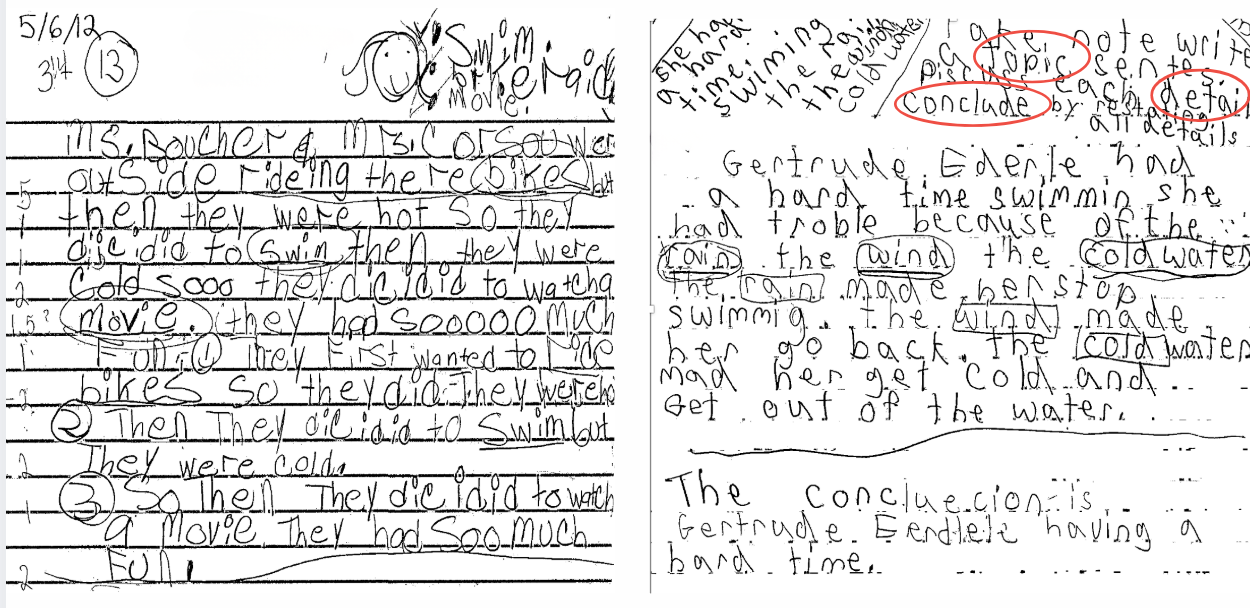
I began teaching and researching TDC immediately after developing it, still in early 2012. Here are post tests from a group of students who learned and applied TDC to weekly Quick Writes, collected after two months of instruction in TDC. Notice the different ways students internalized the process. One student listed only her 3 details in her plan at the top, while another put his full self-talk that he used to guide himself in using TDC. Since then I’ve learned to do more modeling that looks more like the student on the left. Less is more. But keep in mind that with Quick Writes, students may abbreviate the full P3 and O process like this.
The Field Responds: TIDE Emerges
What happened next was genuinely exciting. Researchers began studying the informative Quick Write structure — and in doing so, they made their own refinement. The TDC mnemonic became TIDE: Topic sentence, Important Details, Details, Ending — and research validation followed. TIDE appeared in books (Mason et al., May 14, 2012) and then research studies. While TIDE lost the precise CCSS term ‘conclusion’, changing this to E – end made it more memorable.
I shifted to this derivation right away. That’s how a field grows. Researchers listen to the field, innovate and further researchers take an idea, refine it, study it rigorously, and extend the evidence base. Schools, in states far apart across the USA that worked with us began to spontaneously tell us that TIDE can actually work for both informative and opinion writing – for both regular and Quick Writes. Less is more. Some schools took a few years to shift to only one mnemonic, but began to see this over time as well and simplified to TIDE for both genres. Fast forward to 2025, and new research confirmed that teaching TIDE alone raises both informative and persuasive writing (Kim et al, 2025).
We have older TREE and TDC materials that we’re happy to share with anyone who’d like them — just reach out. We no longer actively promote TREE or TDC, because we think TIDE works beautifully and has a strong evidence base behind it.
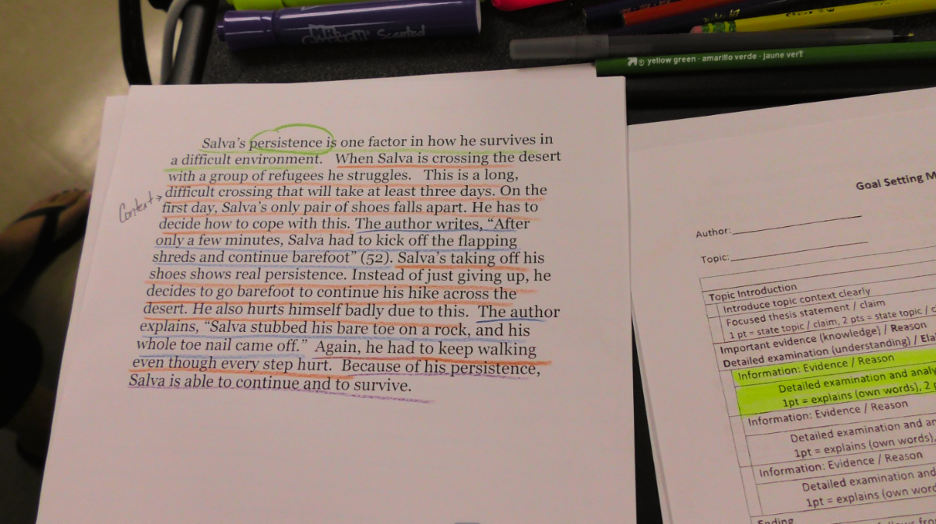
Wondering how to score a TIDE Quick Write? Here is a fantastic innovation from a teacher who had students highlight just one ID section on the scale, write only one ID and score for only that.
Don’t Overlook Opinion Quick Writes— Especially in the Early Grades!
Before we go further, let’s make a case for something that can get overshadowed in the push toward academic writing: opinion writing is fun. Particularly in the early grades, it is one of the most engaging entry points into writing we have. Just because the Quick Writes and many other researchers have shifted to TIDE, let’s still be sure to do a lot of opinion writing too!
‘Write about your favorite planet and why.’ ‘Who is your favorite character in this story, and what makes them special?’ These aren’t trivial prompts — they’re invitations to reason, to make an argument, to use evidence from text, and to care about what you’re writing. Students who won’t pick up a pencil for a summarization task will happily argue for their favorite planet for ten minutes.
If you are thinking but Quick Writes are intended to foreground content learning, can that mesh with opinion writing – Yes! Way back, I used to have my students write persuasive pieces (favorite pet, webcams in the classroom, good or bad?), but I learned to do less of this and more opinion writing in response to rich, complex text for several reasons. Writing opinions about texts read compels deep engagement with the academic language in them.
Even more – the Common Core State Standards make an important distinction worth sitting with that differentiates opinion (drawing on facts from texts) versus persuasive writing (favorite pet). While there is room for both and we celebrate fun writes about our weekend too – much of our writing, including Quick Writes, is best done in response to rich content. As the CCSS Appendix A guided us:
“A logical argument convinces the audience because of the perceived merit and reasonableness of the claims and proofs offered – rather than either the emotions the writing evokes in the audience or the character or credentials of the writer (as persuasion e writing does). The Standards place special emphasis on writing logical arguments as a particularly important form of college- and career-ready writing.”
This is the deeper goal beneath the fun of opinion writing. We want students who can construct a reasoned case — not just express a preference, but support it with evidence and logic. Quick writes are a perfect low-stakes, high-frequency practice ground for exactly this skill, and work in informative or opinion writing. Win win. Use them for both.
Teaching Quick Writes Over the Year
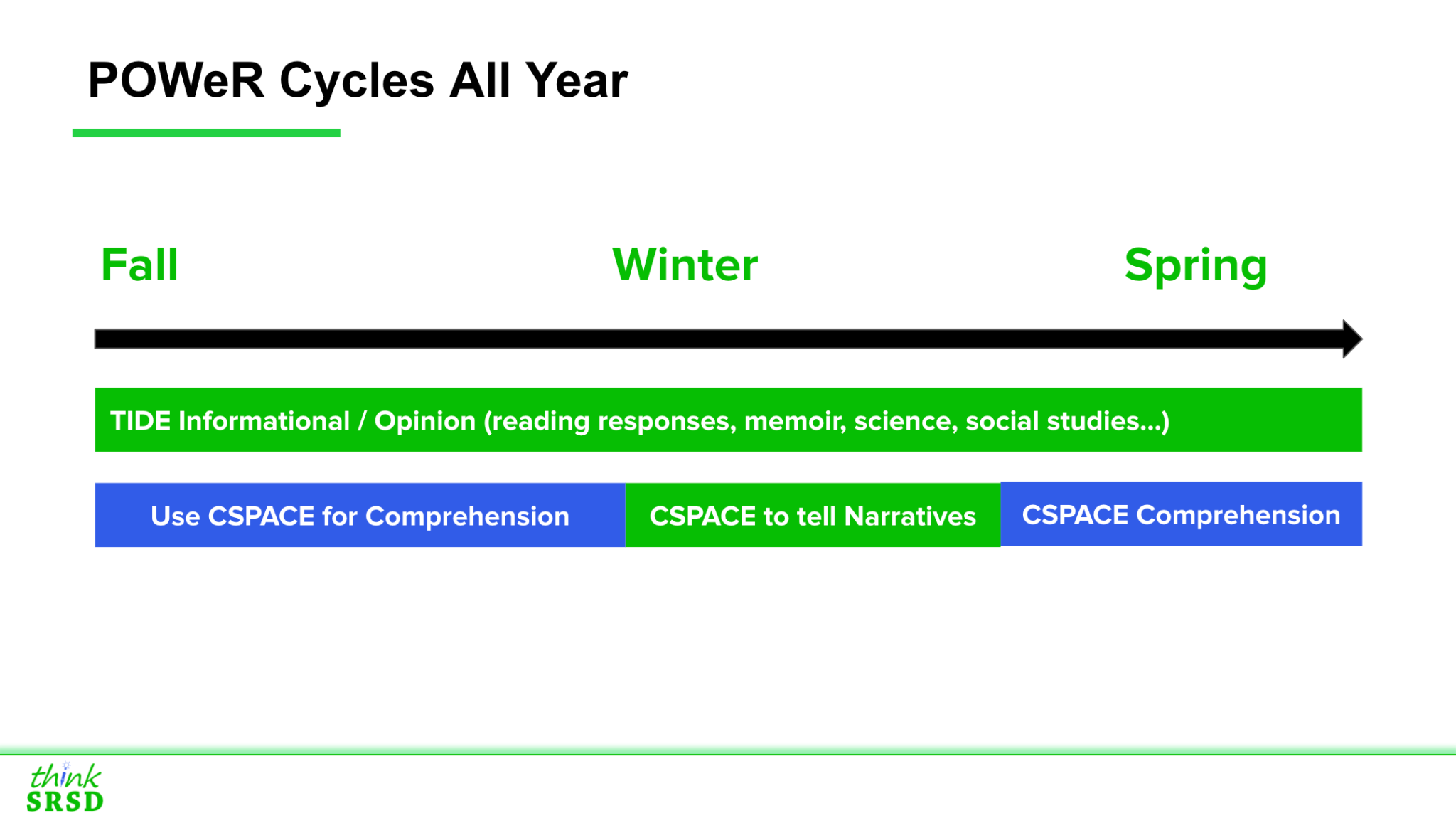
One of the most common mistakes teachers make with Quick Writes is treating them as occasional events rather than a regular practice. The research is clear: frequency matters. Students need repeated opportunities to apply their strategy, get feedback, and build fluency.
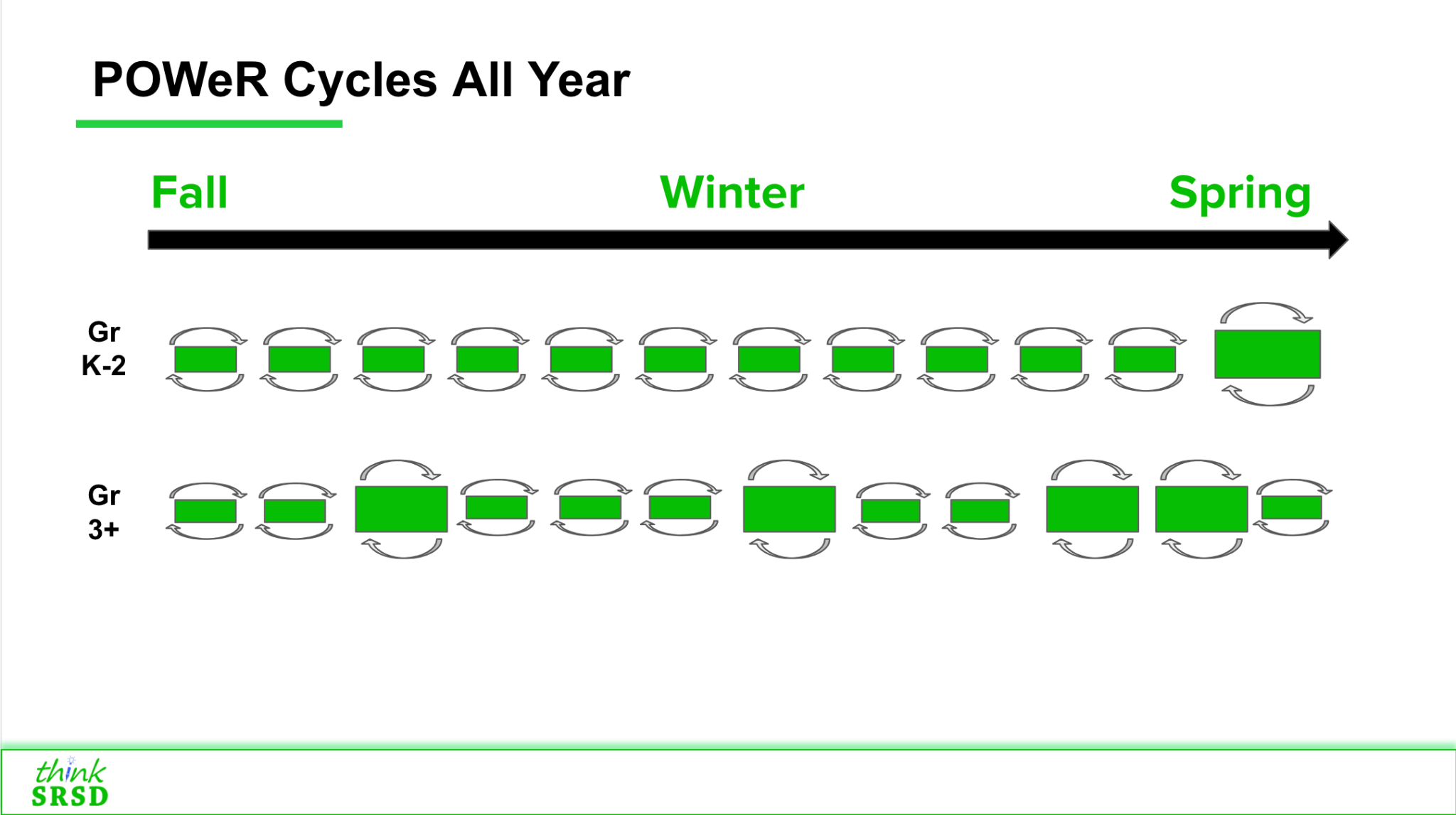
A few principles for building these in sustainably:
• Start with opinion. The structure of opinion writing tends to be more intuitive — students already know how to disagree! Use low-stakes, high-interest topics from your science, social studies or HQIM as sources to argue about.
• Remember to also teach C-SPACE for narrative. C-SPACE — Characters, Setting, Purpose/Problem, Action, Conclusion, Emotions — appears to have been studied as early as 1997 and offers a parallel scaffold for narrative writing. Quick writes don’t have to be limited to informative and opinion genres. Just this week in our Facebook group, teachers are showing how early they introduce both TIDE-L and CSPACE-L.
• Build in celebration. Self-regulation research consistently shows that self-monitoring and self-reinforcement are not optional add-ons — they’re part of what makes strategy instruction work. Students who graph their own progress and notice their own growth become more motivated writers. Make the improvement visible.
The Bottom Line
Quick Writes work. The research base — built carefully over years, from the strategy instruction roots at Kansas through Mason’s pioneering Quick Writes studies to the emergence and validation of TDC then its derivation TIDE — gives teachers something solid to stand on.
But more than the research, Quick Writes work because they respect students. They say: you can do this, you have something worth saying, and here’s a structure to help you say it well. In ten minutes. About something that matters and with tools that empower students to express themselves while building access through command of academic language.
Need any assistance? Reach out — we’re happy to share, support and answer questions. For more on integrating Quick Writes systematically across your year with TIDE-L and CSPACE-L, visit ThinkSRSD.com.
References
Benedek-Wood, E., Mason, L. H., Wood, P. H., Hoffman, K. E., & McGuire, A. (2014). An experimental examination of quick writing in the middle school science classroom. Learning Disabilities–A Contemporary Journal, 12(1), 69-92. POW+TIDE
Kim, Y. S. G., Harris, K. R., Goldstone, R., Camping, A., & Graham, S. (2025). The Science of Teaching Reading is Incomplete without the Science of Writing: A Randomized Control Trial of Integrated Teaching of Reading and Writing. Scientific Studies of Reading, 29(1), 32–54.
Laud, L. E., & Patel, P. (2008). Teach struggling writers to unite their paragraphs. TEACHING. Exceptional Children Plus, 5(1)
Mason, L. H., Benedek-Wood, E., & Valasa, L. (2009). Teaching low-achieving students to self-regulate persuasive quick write responses. Journal of Adolescent and Adult Literacy, 53(4), 303-312. POW+TREE
Mason, L. H., Kubina, R. M., & Taft, R. J. (2011). Developing quick writing skills of middle school students with disabilities. Journal of Special Education, 44(4), 205-220. POW+TREE
Mason, L. H., Kubina, R. M., Valasa, L. L., & Cramer, A. M. (2010). Evaluating effective writing instruction for adolescent students in an emotional and behavior support setting. Behavioral Disorders, 35(2), 140-156. POW+TREE
Mason, L. H., Kubina Jr, R. M., Jr, Kostewicz, D. E., Cramer, A. M., & Datchuk, S. (2013). Improving quick writing performance of middle-school struggling learners. Contemporary Educational Psychology, 38(3), 236-246. POW TREE
Mason, L. H., Reid, R., & Hagaman, J. (May, 2012). Building comprehension in adolescents: Powerful strategies for improving reading and writing in content areas. Brookes Publishing. POW+TREE