
In the 1970s, Dr. Don Deshler and his team at the University of Kansas were grappling with a persistent question: how do you make learning stick? Undeterred, they pursued and secured a multimillion dollar federal grant to study and solve it, and won. Decades later, their impact endures and continues to grow. Dr. Deshler outlined a set of steps that form the foundation of Releasing Writers (formerly thinkSRSD) today. Validated across many rigorous studies, these steps embody mechanisms that align beautifully with what today’s science of learning movement supports, including explicit instruction, retrieval practice, gradual release, and regular feedback.
Within the field of Evidence Based Practices for Writing (EBP-W), these concepts have proven durable. Dr. Carol Sue Englert was another pioneer who applied many of these same principles in her Cognitive Strategies Instruction (CSI) model and saw strong results. Graham and Harris later studied Deshler’s original steps, rebranding them as stages while preserving the same underlying concept, and found the same success he did, further validating his foundational work. Others, such as Carol Olson and the National Writing Project, have focused on the most critical elements (explicit instruction, modeling, and feedback) and produced some of the strongest real world results in the field, including measurable gains on state assessments.
Years ago, Releasing Writers began “lifting the hood,” examining the most well validated underlying mechanisms common across the strongest, most evidence supported writing approaches. To consolidate and synthesize these mechanisms, and most importantly, to make them easier for teachers to learn and use, Releasing Writers bundled them together into the Power Cycle. With support from multiple federal grants (IES, EIR) and close oversight from excellent program officers at these agencies, Releasing Writers tested the Power Cycle and found strong gains in feasibility and usability, as well as in state assessment outcomes.
Figure 1: Deshler’s Six Steps
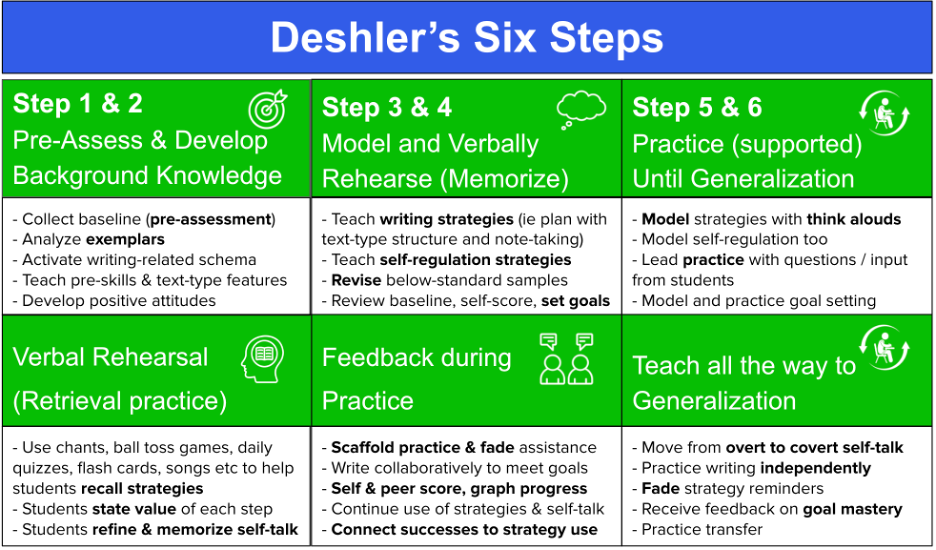
Step 1 & 2: Pre-Assess and Develop Background Knowledge, Discuss It
Collect a pre-assessment writing sample and assess knowledge of genre terms. Analyze exemplars and below-standard samples. Teach pre-skills, text-type features, and self-regulation strategies. Introduce the mnemonic (POWeR, TIDE-L), explain its purpose, and discuss when to use it. Review baseline performance, set goals, and build positive attitudes toward writing. Releasing Writers adds color coded exemplars for extra explicitness and launches self-regulation from the start.
Step 3 & 4: Model It and Memorize It
Model each strategy step through think alouds, weaving in self-talk to demonstrate how to cope when writing gets hard. Model scoring and goal setting. Use retrieval practice (chants, ball toss, quizzes, flash cards) so students recall and state the value of each step. Students memorize and personalize self-talk until it feels natural and they can explain why each strategy matters.
Step 5 & 6: Practice all the way to Independent Generalization
Scaffold practice and fade assistance as students apply strategies and self-regulation together. Write collaboratively, self and peer score, graph progress, and connect successes to strategy use. Shift from overt to covert self-talk. Fade strategy reminders and teacher made organizers as students draw their own, practice independently, and transfer strategies across disciplines, teaching all the way to generalization.
Releasing Writers consolidated Steps 1 and 2 into collecting a pre-assessment, then introducing the key tools and discussing them. Since introducing and modeling a strategy is not enough, Releasing Writers created the Power Cycle to show right from the start that this is not a linear learning process, but a cyclical one. You lay the foundation in your first Power Cycle, then repeat it as many times as needed until students reach generalization and can move forward as more capable, independent, and powerful learners, aligned to the visual of Zaretta Hammond.
Our adaptation to a ‘Power Cycle’ model is not a departure or deviation from SRSD; it’s a refinement designed for long-term implementation. It includes all the essential activities of the 6 stages delivered in the same sequence, and terms Deshler originated and that various models of EBP-W include, each in customized ways that adhere to fit and fidelity. Our peer-reviewed published studies that have examined the Power Cycle underscore its effectiveness in helping schools sustain EBP-W over a full year, correlating to ELA proficiency gains as well.
What is the Power Cycle?
A POWeR Cycle is a structured approach to teaching writing, where “POWeR” stands for Plan, Organize, Write, edit and Revise. It’s a repeating process, using new texts and prompts, to build self-regulation and independence in writing strategies and self-regulation skills.
Each cycle involves explicit instruction in the key strategies, collaborative work, and independent practice that are the basis of the stages, with opportunities for self-assessment and goal setting each week. We augmented the focus you see most often across EBP-W studies on text structure organization (TIDE) to build all levels of language use including vocabulary and syntax, ensuring there is no Swiss cheese – all sub-elements needed to write well are covered as well with well established and evidence-based practices for each.
The POWeR Cycle was born of necessity. After working with thousands of teachers on a daily basis over twenty years, we identified a barrier. Teachers shared the same questions and got stuck in the same places. For example, they wanted to know what happened after Stage 6.
We learned that the stage names and numbers were not as important as what you DO in each stage. The core mechanisms — the explicit teaching of strategies, the self-regulation skills, and the gradual release of responsibility — are what lead to student outcomes, rather than the name of the stage. The SRSD framework and content remains exactly the same, but how we presented it made it easier to keep the momentum going all year.
Releasing Writers created TIDE (TDC) in 2012, then augmented this to TIDE-L based on new research showing that text structure (TIDE) and Language (L) were the strongest correlates to overall writing quality. Not beholden to one researcher or model, we use POWER (Englert et al, 1991) since this provides a reminder to use all the phases when we write rather than dashing to drafting, then ending. POW was introduced then used regularly in SRSD in 2003, though POWER was mentioned in SRSD in the late 1990s.
“Cycle” appears in SRSD studies around the same time, in the mid 2000s, to explain the concept that students will repeatedly use the strategies and self-regulation skills weekly, graphing gains as they meet their goals, then using the strategies and self-regulation skills again to meet increasingly challenging goals each week.
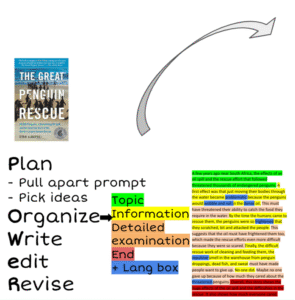
Figure 2: Launch POWeR Cycles
Introducing these tools allows you to set up and launch the POWeR Cycle. Next you model using these and support your students in a gradual release process as they begin to use them and self assess their progress.
The POWeR Cycle guides teachers in how to cohere and introduce the major elements of the Six Stages in an easy to recall, light-lift and high yield way. It makes it easier for teachers to understand and begin teaching the key elements from the 6 Stages in a smoother way. In our experience coaching thousands of teachers in hundreds of schools, we found that once teachers worked through the activities in the 6 Stages, they wanted to know where to go next. After students reach independent performance, they would work through the stages again with new goals or to learn a new genre text type. Calling these POWeR Cycles helped teachers see this and do this more quickly.
Figure 3: Run POWeR Cycles

1. Model Processes: On the left you see ‘your texts’. That is where you now show your students how to use the strategies they learned with the texts and topics you teach. Model using POWeR to respond to these in front of the class using think-alouds and involving students by eliciting their input as you go. Importantly, you can have students write self-statements on their pre-assessment, then on their notes and their paper as they write, even on their rubrics when they self-score.
2. Teach Features: Use a goal-setting menu and rockets to drive editing, revision, self-evaluation and peer feedback. Model scoring both exemplars and ‘below-standard’ pieces so your students learn the features of effective writing. With practice, students use to self-monitor their progress. As they chart their gains, they can self-reinforce when they see their progress.
Figure 4: POWeR Cycles all year

Figure 5: After Ten POWeR Cycles – Self-regulation Grows

Researchers describe this gradual release in different proprietary terms (steps, stages) for the same concept. What truly leads to student outcomes are the underlying mechanisms—the strategies, self-regulation skills, and gradual release of responsibility. The name of the stage is not what matters. Think of it like a car engine: it’s not the model name of the engine that powers the car, but rather the specific, coordinated actions of its pistons and gears. Our work focuses on helping teachers understand and use those powerful mechanisms, not on the label we put on them.
The evidence-based practices for writing (EBP-W) and content remains exactly the same, but our presentation of it makes it easier for teachers to keep the momentum going all year. We don’t focus on proprietary or branded names; we focus on the activities and mechanisms that actually help children become better writers.
The activities within each stage are what matter, and teaching these in a gradual release “I do, We do, You do” framework. Practical application is the key. These activities, and the staged gradual release framework, inspired think SRSD’s POWeR Cycle. The beauty of the field of EBP-W is how flexible it is. Continuously streamlining the presentation while keeping the core pedagogy intact is important for any evidence-based practice. Rather than a dilution, these evolutions of a brilliant model are crucial to ensuring you can bring these to your students. When keeping fit and fidelity in mind, such teacher-centric adaptations to local contexts enable it to endure, integrate with your curriculum and withstand the test of time.
Still curious? If you are familiar with gradual release models, you may appreciate this graphic that shows how the mechanisms in the POWeR Cycles overlays on this.
Figure 6: 6 Steps or Stages Overlay on POWeR Cycle

Deshler, D. D., Alley, G. R., Warner, M. M., & Schumaker, J. B. (1981). Instructional practices for promoting skill acquisition and generalization in severely learning disabled adolescents. Learning Disability Quarterly, 4(4), 415–421.
Harris, K. R., Graham, S., & Mason, L., & Friedlander, B. (2008). Powerful writing strategies for all students. Brookes.